
she talks in books
no makeup literature
After a doom scroll on Goodreads recommendations, her “want to read” section seems like a sour spot in her pale yellow window. The screen is minimised in a rectangle she bluntly describes as more aesthetically pleasing than any other ninety-angled quadrilateral; she despises squares, more so the roads and places named on squares, like Times Square, or just any other square her mind is not getting at right now. Because a square is a cage, but a rectangle is a doorway.
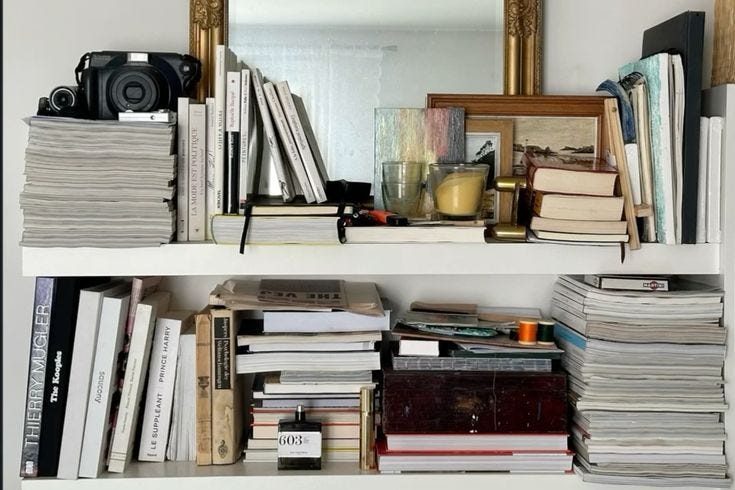
She wanted nothing but a story she could complete in a day or two, with chapters under twenty and dedication pages adrift and long acknowledgements to people the writer was thankful for. Her idea of a perfect book is very direct and classified, but if you asked her on a sunny day, lying on the cushion beanbag, her hair in an articulate bun, strands of her whiskers in disarray, she would look at you for a minute or two to judge whether you are just asking for the sake of asking or truly want to know. Then she would keep the worn-out copy of Normal People by Sally Rooney beside the stack of paperbacks she calls her “foster children,” placed beside the coffee table which smells of beans and sugar, and she would give you the monologue, and mind you, it will be the same even if you just asked for the sake of it.
Her fingers will not leave the worn-out cover of the folded book; they are jittery when she tells you that she had read more than a thousand books in seven years and that once she liked the writing style of an author and how their characters relate to real-life people, she will barely leave any books of that author unread. She will later also explain that some manga and movie scripts are included in those thousands, and that they are also stories — stories that felt the need to be expressed in such a way that words weren’t enough to suffice. She will tell you that she doesn’t particularly hate movie adaptations of a few favourite books, and why she wishes some were never made, fully contradicting her prefatory comment.
You will raise your good- or bad-shaped eyebrow, and then she will start by saying that everything has a face value. She might seem materialistic to you — and she actually is, if you get to the later part — but as with all people, you might find that her honesty about this is what she truly likes a book about.
She will recollect as many blueprints as there are about different tropes and the same characters and the same lifestyle, all having different beginnings and the same endings. She will put some character names here and there, later summing them up in terms like ‘fl,’ ‘ml,’ ‘mml,’ ‘hea,’ ‘ow,’ and the Reddit page. She will tell you this so many times: she worships that grail before a book release, and how she secretly doesn’t give away recommendations to a few books just to keep them to herself.
She might not remember the books she laughed her head off at, but the best of her reads were the ones she shed her most tears over. It will be the small things, to be honest.
Silas and I get into the other bed… “You’re here.”
Where she finally gets to the name of the main character in The Heart the Lover by Lily King.
Or in The Love Affair by C. P. Snow:
“The sense of unhappiness is so much easier to convey than that of happiness… But happiness annihilates us: we lose our identity.”
She likes that line more than she admits.
And when she talks about preserved moments, about how objects sometimes remember better than people, she means The Museum of Innocence by Orhan Pamuk:
“To explain why we have chosen this moment over all others… We can bear the pain only by possessing something that belongs to that instant. These mementos preserve the colors, textures, images, and delights…”
She understands that instinct. To archive love before it decays.
When she speaks about being on the fringe of success, never fully stepping into the world, she means Stoner by John Williams:
“In the world you would always be on the fringe of success, and you would be destroyed by your failure… You are for this world, and you are for this place. You are for the university.”
And later:
“If I had been stronger… if I had known more… if I could have understood… if I had loved her more.”
That kind of regret does not scream. It settles.
She will also recount the laughs in Jinwoo Chong’s novel, I Leave It Up to You:
“A little thumbs-up appeared over my text. Appa had surprised me there with his tech savvy.”
The man returned from a coma in the Covid period to be a chef.
“Rocket stares out the cracked window, a light breeze rustling his fur. He doesn’t stick his head out. That would be too undignified. Instead, he observes.”1
Or the POVs of dogs at the end of the story.
She will show you these sides and also where her heart broke many times:
“I’ll never be able to choose one scenario over another. And how could I without Gabe? It would have taken us both. When I imagined these possibilities, it was like running a simulation, with Gabe’s avatar controlled by me. Every time, I played both roles.”2
Or when she felt the writer character was just talking to her:
“It really scares me, Sam. When you lie and manipulate people? It reminds me of your father.”3
When she remembers quiet crying that feels inherited, she means The Perks of Being a Wallflower by Stephen Chbosky:
“My grandfather was crying. The kind of crying that is quiet and a secret…”
She never decides if that passage is hopeful or tragic. Maybe both can exist.
When she says being seen can feel violent without anyone touching you, she means Never Let Me Go by Kazuo Ishiguro:
“We hadn’t been ready for that… being seen like that, being the spiders.”
She knows that feeling. Of being examined.
When she questions parenthood, disappointment, and survival itself, she means A Little Life by Hanya Yanagihara:
“Was this what being a parent was like? … Such unhappinesses, such disappointments, such expectations that would go unexpressed and unmet!”
And:
“The only trick of friendship… is to find people who are better than you are… kinder… and to trust them, which is the hardest thing of all.”
She underlines that twice.
And when she talks about being suspended between eighteen and nineteen, about time looping before adulthood arrives and ruins it, she means Norwegian Wood by Haruki Murakami:
“Only the dead stay seventeen forever.”
She reads that and does not know whether it comforts her or frightens her.
She will also say that sometimes it is not the plot but a single sentence that converts you, and she will quote from Daniel Deronda by George Eliot about revelation only happening when one personality touches another and subdues it into receptiveness.4 She will say that is what books do; they do not change you loudly, they touch you, and you do not notice until much later.
A square is a cage.
A rectangle is a doorway.
And her shelves are not storage. They are doorways she has already walked through and sometimes still lives inside.
If It Makes You Happy- Julie Olivia
The Light We Lost- Jill Santopolo
can’t remember
It is one of the secrets in that change of mental poise which has been fitly named conversion, that to many among us neither heaven nor earth has any revelation till some personality touches theirs with a peculiar influence, subduing them into receptiveness.
Books Mentioned (Oct 2025 – Jan 2026)
Normal People — Sally Rooney (second read)
The Heart the Lover — Lily King
The Love Affair — C. P. Snow
The Museum of Innocence — Orhan Pamuk
Stoner — John Williams
I Leave It Up to You — Jinwoo Chong
The Perks of Being a Wallflower — Stephen Chbosky (second read)
Never Let Me Go — Kazuo Ishiguro
A Little Life — Hanya Yanagihara
Norwegian Wood — Haruki Murakami
Daniel Deronda — George Eliot
If It Makes You Happy — Julie Olivia
The Light We Lost — Jill Santopolo